Aslim Taslam
All the Old KnivesAslim Taslam is a militant group whose stated refusal to compromise becomes the governing fact of the hijacking of Royal Jordanian Flight 127. Formed after a split from Somalia’s Al-Shabaab, it has built connections with Ansar al-Islam and carried out deadly attacks across several cities. In Vienna, its members use an ordinary passenger flight as a hostage site, while their declared intentions and calculated threats leave Austrian and German officials facing a brutal choice: meet the demands or risk the deaths of everyone aboard.
Identity and Background
Aslim Taslam emerged from a break with Al-Shabaab over an ideological dispute. Reports have suggested that the dispute concerned the use of drug money to finance operations, though the account presents this as a reported possibility rather than a settled explanation. After the split, the group approached Ansar al-Islam, a Sunni organization formerly based in Iraq and now based in Iran, for assistance. Ansar al-Islam supplied financial and logistical support, including shared networks and operational planners; the account suggests that the Iranian government may have encouraged this relationship.
The resulting cooperation alarmed American intelligence observers because the organizations involved would otherwise be antagonistic. Langley watched the developing connection from a distance as Aslim Taslam’s profile rose. In the year before the Vienna crisis, the group had been responsible for deaths and explosions in Rome, Nairobi, and Mogadishu. Its growth gives the hijacking a significance beyond a single aircraft: the event is presented as the work of an increasingly capable organization whose reach extends beyond its Somali origins.
Doctrine and Methods
A Damascus station report identifies Aslim Taslam as the group behind an anticipated airline-related event within 72 hours, probably involving a flight headed to Austria or Germany. The departure point remains uncertain, with Damascus, Beirut, and Amman among the possibilities. The report assesses the likelihood as high and notes that the principal actors may be recruits from outside Somalia. When the hijacking occurs, the forecast’s central elements prove accurate: the flight departs from Amman for Austria, and the hijackers identify themselves as Aslim Taslam members.
The group’s doctrine is described through a manifesto drafted in Tehran in March 2004 and distributed by email from Mogadishu. Henry Pelham says it makes clear that the group will accept nothing short of its demands and will die rather than settle for less. He cites an earlier episode in Kinshasa, where, after Congolese authorities attempted negotiations, members set off an incendiary device in a central police station, killing themselves and those inside. For Henry Pelham, this history means the threat cannot be treated as rhetorical bargaining: Aslim Taslam is dangerous precisely because it is depicted as acting on its declared commitments. His certainty conflicts with the conventional starting point proposed by Ernst Pul, negotiation, and helps shape the American team’s assessment of the crisis.
The Seizure of Royal Jordanian Flight 127
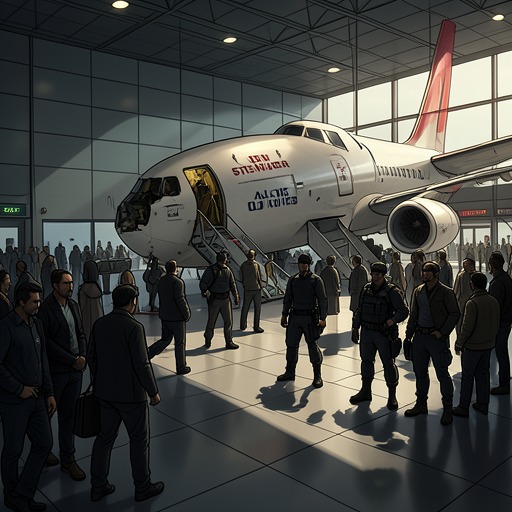
Royal Jordanian Flight 127 is an Airbus A319 that leaves Amman at 10:35 a.m. and lands in Vienna at 1:25 p.m. The aircraft has capacity for 138 people and carries 120 passengers and crew. According to the account assembled from the passenger manifest and the pilot’s report, the four hijackers cause no disturbance during the three-hour-and-fifty-minute flight. Immediately after landing, they stand up. Suleiman Wahed, seated near the rear, shoots a stewardess in the chest when she rises and asks him to sit down. The other identified hijackers are Ibrahim Zahir, Omar Ali, and Nadif Guleed; officials have their passport photographs but little further information.
The hijackers tell passengers in Arabic and English that they will kill anyone who disobeys them but do not intend to use the plane as a weapon. They describe it as a safe house until their demands are met, after which the aircraft will fly elsewhere and the passengers will be released. Their conduct immediately gives the threat force: nine children, aged between five and twelve, are moved to the front of the cabin as human shields and as leverage against anyone attempting to intervene. The hijackers explicitly threaten to kill one of the children if anyone interferes.
Their demand is for five prisoners—two held in Austria and three in Germany—to be released within 48 hours. Seventeen Americans and twenty-nine Germans are reported to be aboard, with the American count still being verified. The officials also weigh the domestic political stakes: Germany’s new chancellor, Angela Merkel, might concede, while Austrian president Heinz Fischer faces pressure from the right and Social Democrats over immigration. The hostage crisis is therefore bound to national politics as well as to the hijackers’ deadline.
Crisis, Refusal, and Consequences
Henry Pelham argues that the manifesto leaves little room for a negotiated settlement: either the prisoners are released or the hostages die. Owen Lassiter agrees that the group’s record makes an assault before the deadline the only alternative if Austria and Germany refuse the demand. Victor Wallinger, however, distinguishes the American role from direct intervention, insisting that the Americans are advising the Austrians rather than storming the aircraft themselves. The disagreement exposes how the group’s absolutism pushes officials toward extraordinary choices while responsibility for carrying them out remains politically sensitive.
The presence of television cameras at the airport fence further complicates the response. The hijackers have called the media, and Celia Favreau recognizes that the cameras are meant to watch events outside the plane. Even if Austrian officials cordon off reporters, she argues, broadcasters will speculate about the reason; an order to retreat could itself make an assault seem imminent. The hostage operation thus includes an audience beyond the passengers and officials. Aslim Taslam’s leverage depends not only on the people inside the cabin but also on what observers outside may infer.
The eventual messages and sounds from the aircraft reinforce the group’s declared refusal to bargain. The planned assault is called off after a final message attributed to Ahmed, though Ernst Pul doubts that the message genuinely came from him. The Austrians begin receiving signals after the aircraft’s engine starts. A message states that Aslim Taslam does not negotiate, and high-resolution cameras record both pilots suffocating in their seats. The scene turns the organization’s formula into an immediate fact of the crisis: the plane remains in place, but its occupants are already dying.
The novel’s final recollection links the flight’s sarin deaths to Henry Pelham’s entanglement with Ilyas Shishani. Henry remembers footage of bodies inside Flight 127, then recalls Shishani’s call after the sarin had killed everyone and his claim that Henry had helped the cause of God. This closing association places the hijacking within a chain of intelligence choices and consequences rather than presenting it as an isolated act of violence. Aslim Taslam’s importance lies both in the specific threat it makes and in the way that threat exposes the limits, compromises, and human costs of the institutions trying to contain it.